
Milk… We are fed milk right from day one of our life, mother’s milk and then weaned on to cow’s milk. For thousands of years human beings have grown up consuming cow’s milk. That is why a cow is treated like a mother in all parts of India. In fact, a cow is considered very holy and sacred for all Hindus.
Milk has a very important place in cuisines worldwide. Desserts from all over the world are mainly made from milk, from ice creams to kulfis, mithais to toffees, cheesecakes to kalakhand. Milk is incorporated in many forms in Indian cuisine. It forms the very basis for our ghee and butter, and of course yogurt or dahi. No Indian home can function without milk. The average Indian man has at least two or three cups of milk tea or chai on a daily basis. Tea vendors can be found on most streets in India doing a roaring business at all times of the day. It is not unusual to see small groups of people holding impromptu discussions with their cuppa of chai. Most Indian households also make their own yogurt or dahi at home.
Milk also gives us paneer, or homemade cottage cheese, which is the strained residue left after the milk has been curdled. Paneer-based dishes are a must in most family gatherings, especially among the Sindhi, Punjabi, and Bengali communities. Normally when the milk is curdled, the remaining clear liquid, which is called whey, is discarded. Whey actually has a lot of nutrients, and there are many households who will put the whey to some use, like kneading bread or roti dough with it.
Today’s recipe is based on milk which has been curdled. This easy-to-make dish is based on a long-lost memory. Years ago milk was delivered early in the mornings by the milkman. It used to come in glass bottles. Even then the aluminium cover was an indication of low fat and full cream. The blue cover was for full cream milk and the green colour for low-fat milk. I remember my grandfather collecting the milk at 5.30 am from the doorstep as he was an early riser. Baba then took the blue-topped milk bottle and gently kept tilting it back and forth for a good fifteen to twenty minutes. After that, when the bottle was opened, the milk had already separated, with the fat rising to the top and forming a layer of white butter, which mummy used to scoop out into a bowl for our breakfast. The remaining milk hence turned naturally fat-free.
I remember once my mother was in the kitchen boiling milk and the milk happened to curdle, but she coolly went on boiling it. When the whey had reduced considerably, she added some green masala paste to it and lo and behold, it had turned into a delicious sabji. So based on that is today’s recipe, the milk sabji or as we say in Sindhi, kheeraji bhaji. It is a very simple dish and is delicious at the same time, best eaten with phulkas and a side dish of potato sabji.
Milk Sabji / Kheeraji Bhaji
Ingredients
- 2 onions, finely chopped
- 3 medium tomatoes, thinly sliced
- 1 tbsp finely chopped garlic
- 1 tbsp grated ginger
- Finely chopped coriander leaves
- 12 curry leaves
- 2 tbsps dry kasoori methi
- 1 tbsp cumin seeds
- 1 tsp ajwain (carom seeds)
- Red chilli powder, turmeric powder, garam masala, and salt to taste
- Few drops of vinegar
- 1 litre full-cream milk
Method
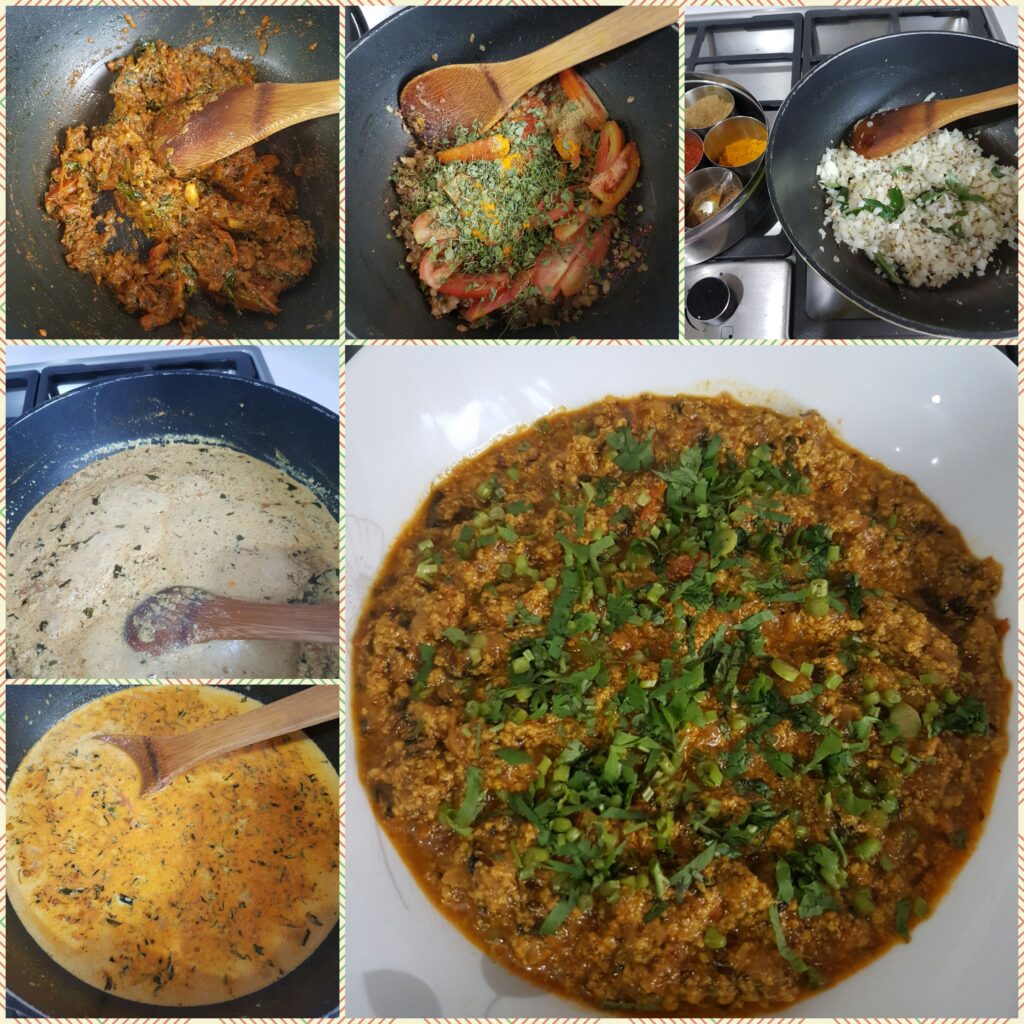
- Heat 3 tbsps oil in a broad saucepan and add the cumin seeds and ajwain. When the seeds stop spluttering, add the onions, garlic, ginger, and curry leaves. Sauté until the onions start turning golden brown. Take care not to burn them.
- Add the tomatoes, red chilli powder, turmeric powder, garam masala, and salt. Mix gently till everything comes together and forms a thick gravy. At this point, add the dry kasoori methi and some coriander leaves.
- Pour the milk directly into the gravy and stir gently, bringing it to a boil. Add a few drops of vinegar and check if the milk curdles. If not, add a few more drops. By this time, the milk should have separated into small grains.
- Keep the milk on a rolling boil, uncovered, for about 15 minutes, then continue cooking on a medium flame until the whey has reduced totally and you are left with a velvety, granular mixture. Add some more coriander leaves and serve hot.