The Sindhi kitchen revisited! Sindhi food is rather simple to make, in the sense that basically onions, tomatoes, ginger, garlic and chillies are what you need to start cooking any dish. We normally don’t use complex pastes made of many spices, and cream or nuts are kept to a minimum. All the recipes handed down in my family are simple, and sometimes even I get surprised when the food turns out to be so delicious in its simplicity.
Growing up in Pune, where most of my mom’s family lived, we frequently visited my Mami Kala’s home, which was the headquarters of the Mohinani family. Many beautiful memories are attached to the nanaron (nani’s home) at Kanyashala Road — those lazy afternoons when all the aunties and cousins gathered for scrumptious lunches arranged by my aunt, the wonderful aromas wafting from the kitchen where the cooks (bhaiyas) literally cooked up a feast, everyone laughing and talking. Memories of that bygone era are truly beautiful. Those were the days when the only way to have a group chat was to meet — and of course, the admin was Aunty Kala. The snacks were more often than not fried, but no one cared — we just enjoyed the delicious food and company.
Today I would like to share a recipe of Beehyan ja Pakora, which is not commonly served nowadays. This snack is quite simple to make and is my mother’s recipe, using lotus stem — or beeh as we call it in Sindhi. My amma (paternal grandmother) loved this snack and would often ask my mom to make it. This vegetable was served on special occasions at home, especially when important guests were invited for lunch or dinner. Mom always cooked it in a rich onion gravy, topped with raw onion slices, a squirt of lime and some sev sprinkled over the curry, and served it with bread buns or pao, making it easy to dunk into the delicious gravy. Lotus stem on its own is quite bland, but it beautifully absorbs the flavours of whatever spices it is cooked with.
Lotus stem is easily available here in Jakarta because it is also widely used in Chinese cooking. In Pune it used to be seasonal — I remember a man who brought lotus stem and pabharees (lotus seeds) all the way from Pimpri, a small satellite town of Pune. Nowadays it is available all year round. As a child I wasn’t very fond of this vegetable, but I have grown to really enjoy it. So here is the recipe — do try it and enjoy.
Bheeyan Ja Pakora (Lotus Stem Pakora)
Ingredients for the Besan Batter (Chickpea Flour)
- 1 cup besan (chickpea flour)
- 1 tsp cumin seeds
- 1 tsp ajwain (carom / thymol seeds)
- 1 tsp red chilli powder
- Salt to taste
- ⅛ tsp soda bi-carb
- Cold water (to make batter)
Method
- Mix all the above ingredients with cold water to make a smooth batter of dropping consistency.
- Keep aside for 30 minutes.
Ingredients for the Beeh Wada (Lotus Stem Filling)
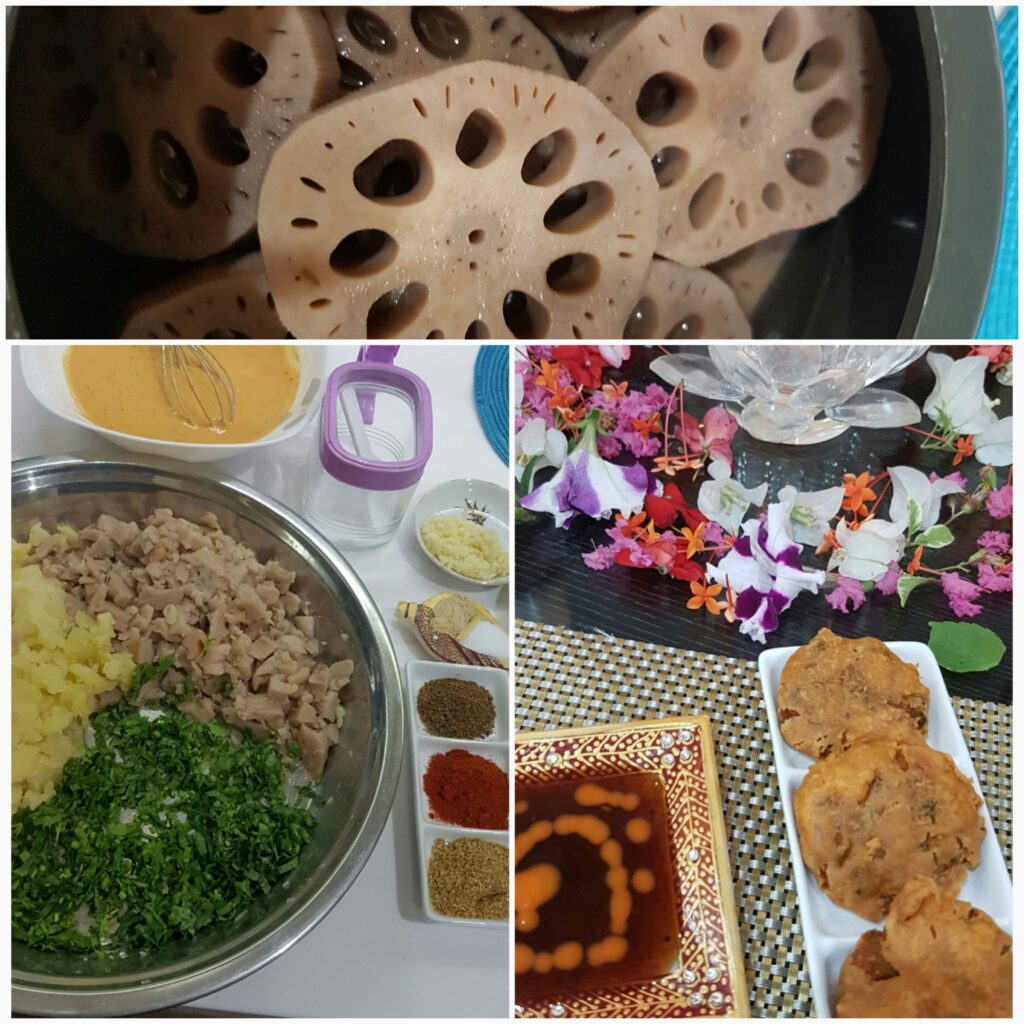
- 1 beeh stem (about 25 cm long), peeled, cut into thick circles and boiled till tender
- 1 tsp ginger paste
- 1 tsp garlic paste
- 1 tsp green chilli paste
- Finely chopped coriander leaves
- 1 boiled potato, peeled
- 1 tsp coriander powder
- 1 tsp garam masala
- ½ tsp amchoor powder
- 1 tsp shah jeera
- Salt to taste
- Oil for deep frying
Method
- In a large bowl, roughly mash the boiled potato and boiled beeh. The mixture should remain chunky.
- Add all the dry spices, salt, ginger, garlic, green chilli paste and coriander leaves. Mix well.
- Shape the mixture into small balls and keep aside.
- Heat a wok half-filled with oil.
- Dip each lotus stem ball into the besan batter and gently slide into the hot oil.
- Fry until light golden, remove and keep aside.
- When ready to serve, gently press each ball between your palms so it flattens and cracks.
- Deep-fry again until golden brown and crisp.
- Serve hot with cold mint chutney.