The Indian comfort food which we all have grown up with is dal and chawal, right from the time when we are babies, we are fed dal and khichdi, wholesome food and protein packed. Dal, or lentils as it is known in the West, is a must at almost every meal in India. It is the source of protein for most vegetarians. There being a vast variety of lentils, each having a different texture after being cooked, gives options to the homemakers in giving a varied menu to her family. Of course each region, or for that matter each home, will surely have their own favourite dal.
The South Indians love their sambhars and rasams, both made of tur dal or split pigeon peas, but having a different texture. While a sambhar is thick, rasams are like a thin spicy broth. The North Indians love the whole moong dal, which is cooked to a creamy thick consistency and served in the Gurudwara at langars, which is a community kitchen where meals are served free of charge. And so on, the ways of cooking the humble lentils differ from state to state. In some parts of India, dal is cooked on a charcoal flame or sigri for a few hours, gently simmering away to give a beautiful aromatic and creamy result.
Dal is mostly eaten with rice or sometimes with some Indian flat bread like chapatis or parathas. The Indians love their dal to the extent of incorporating it into their desserts like the Maharashtrian puran poli, which is an Indian flatbread stuffed with a boiled and mashed chana dal which has jaggery and cardamom powder added to it. When well made, it literally melts in the mouth. And the Bengal moong daaler payesh which has a creamy consistency and is made with milk, moong dal and jaggery.
Dal in the Sindhi home which has received worldwide fame is the dal pakwan, a dish of simple boiled chana dal topped with a sweet and sour chutney and onion relish or kechumbo as it is called in Sindhi, and served with a pakwan which is a cumin flavoured flat bread deep fried to a crunchy crispness. The pleasure derived in every bite of the contrasting textures is what has made this breakfast dish so popular.
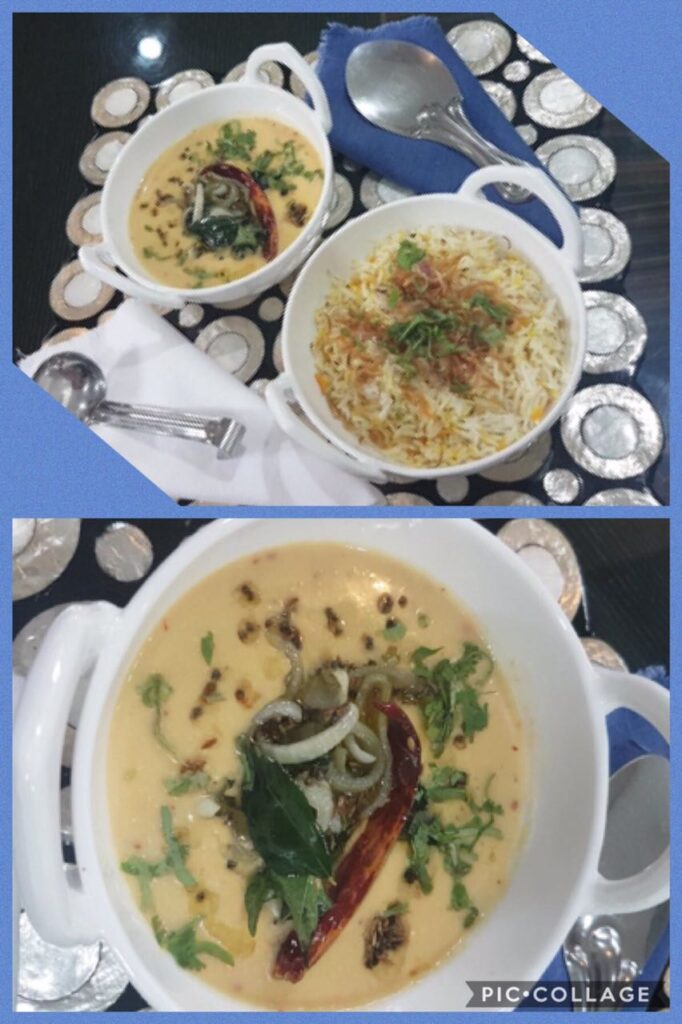
Today I will share with you a simple coconut dal recipe. It is a recipe given in our cooking group by our group member Neetu. I have tweaked the recipe a little and made a few changes. Do try this amazing dal, which can be eaten with rice or phulkas. The addition of coconut cream takes its texture to a new level.
Ingredients
- 1/2 cup yellow moong dal, soaked and boiled to a mushy consistency
- 6 tbsps fresh grated coconut
- 4 dry red chillies, broken into pieces
- 1 tbsp chopped garlic
- 1/2 tsp turmeric powder
- 3 tbsps coconut cream (I used Kara)
- 2 tbsps coconut oil
Ingredients for tempering
- 1 big onion, sliced
- 3 whole dry red chillies
- 1 tsp mustard seeds
- 1 tsp cumin seeds
- 1/4 tsp hing or asafoetida
- A sprig of curry leaves
- 1 tbsp ghee
Method
- Boil and mash the dal and keep it on a simmer.
- In another pan, add coconut oil and grated coconut. Saute for a while and add the broken red chillies and garlic. Saute till fragrant. Grind this mixture with a little water till smooth and add to the dal along with the turmeric powder. Season to taste with salt.
- At this point your dal will be a pretty peach colour. Simmer for about 5 minutes more.
- Add coconut cream and check the consistency of the dal, which should not be watery.
- Next, heat ghee in a separate small pan and add mustard and cumin seeds to the hot ghee. Also add the sliced onions, curry leaves, hing and whole red chillies. Saute till fragrant and add this tempering to the simmering dal.
Serve the dal with rice or phulkas. Enjoy.