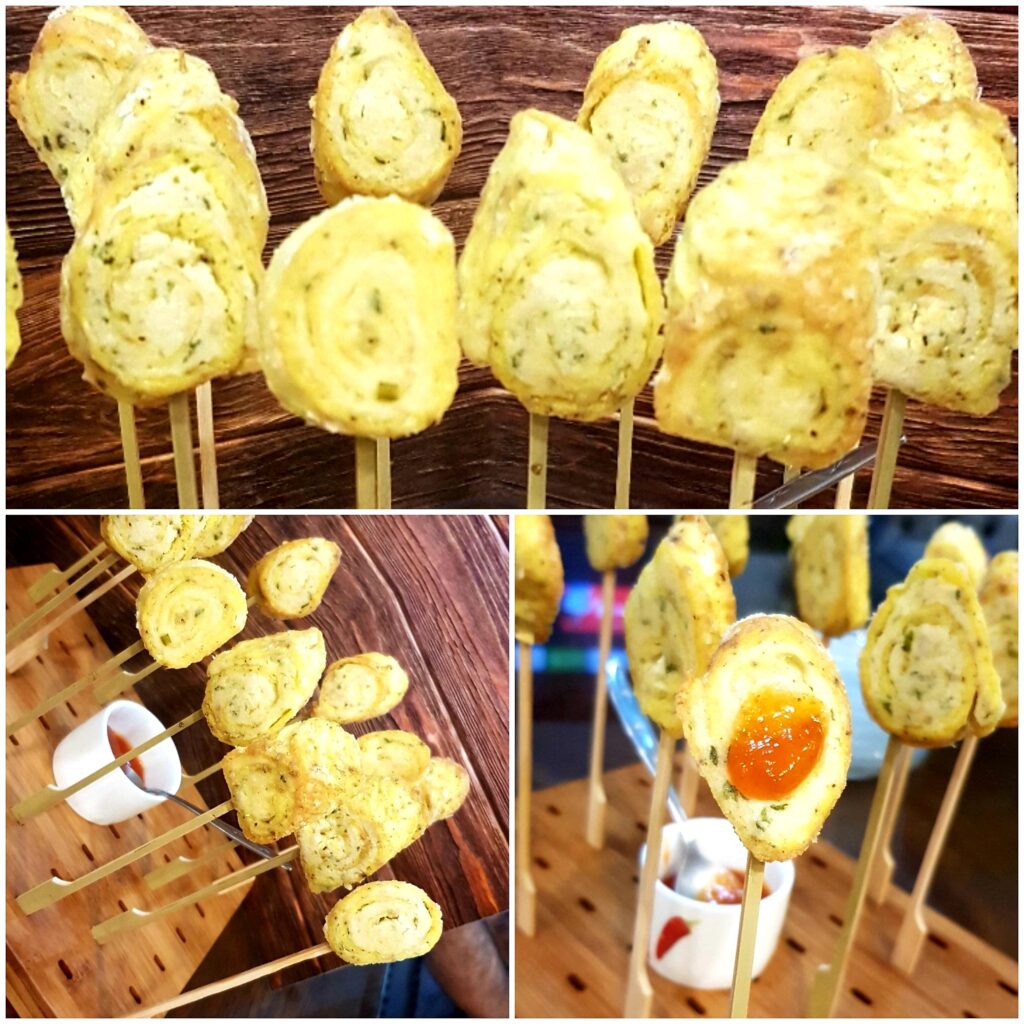
Vegan Omelette With Premix Recipe
instantly make a vegan omelette with this premix
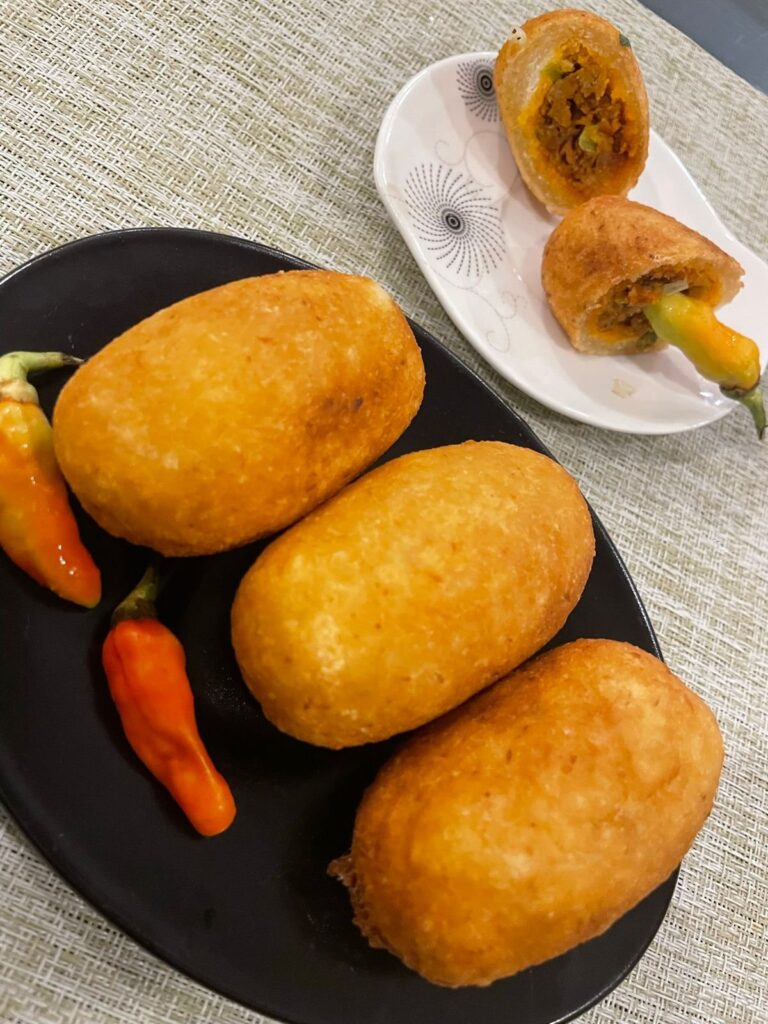
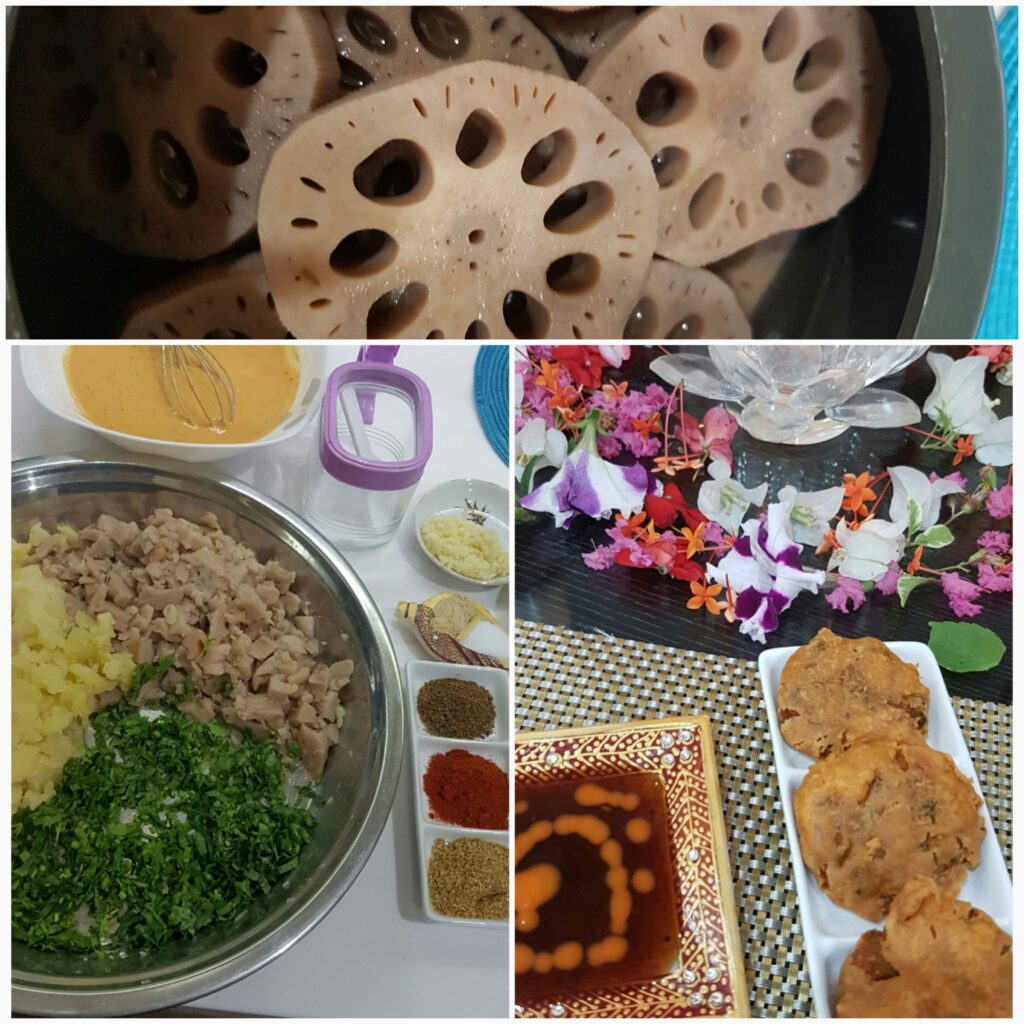
The Sindhi kitchen revisited! Sindhi food is rather simple to make, in the sense that basically onions, tomatoes, ginger, garlic and chillies are what you need to start cooking any dish. We normally don’t use complex pastes made of many spices, and cream or nuts are kept to a minimum. All the recipes handed down in my family are simple, and sometimes even I get surprised when the food turns out to be so delicious in its simplicity. Growing up in Pune, where most of my mom’s family lived, we frequently visited my Mami Kala’s home, which was the headquarters of the Mohinani family. Many beautiful memories are attached to the nanaron (nani’s home) at Kanyashala Road — those lazy afternoons when all the aunties and cousins gathered for scrumptious lunches arranged by my aunt, the wonderful aromas wafting from the kitchen where the cooks (bhaiyas) literally cooked up a feast, everyone laughing and talking. Memories of that bygone era are truly beautiful. Those were the days when the only way to have a group chat was to meet — and of course, the admin was Aunty Kala. The snacks were more often than not fried, but no one cared — we just enjoyed the delicious food and company. Today I would like to share a recipe of Beehyan ja Pakora, which is not commonly served nowadays. This snack is quite simple to make and is my mother’s recipe, using lotus stem — or beeh as we call it in Sindhi. My amma (paternal grandmother) loved this snack and would often ask my mom to make it. This vegetable was served on special occasions at home, especially when important guests were invited for lunch or dinner. Mom always cooked it in a rich onion gravy, topped with raw onion slices, a squirt of lime and some sev sprinkled over the curry, and served it with bread buns or pao, making it easy to dunk into the delicious gravy. Lotus stem on its own is quite bland, but it beautifully absorbs the flavours of whatever spices it is cooked with. Lotus stem is easily available here in Jakarta because it is also widely used in Chinese cooking. In Pune it used to be seasonal — I remember a man who brought lotus stem and pabharees (lotus seeds) all the way from Pimpri, a small satellite town of Pune. Nowadays it is available all year round. As a child I wasn’t very fond of this vegetable, but I have grown to really enjoy it. So here is the recipe — do try it and enjoy. Bheeyan Ja Pakora (Lotus Stem Pakora) Ingredients for the Besan Batter (Chickpea Flour) Method Ingredients for the Beeh Wada (Lotus Stem Filling) Method
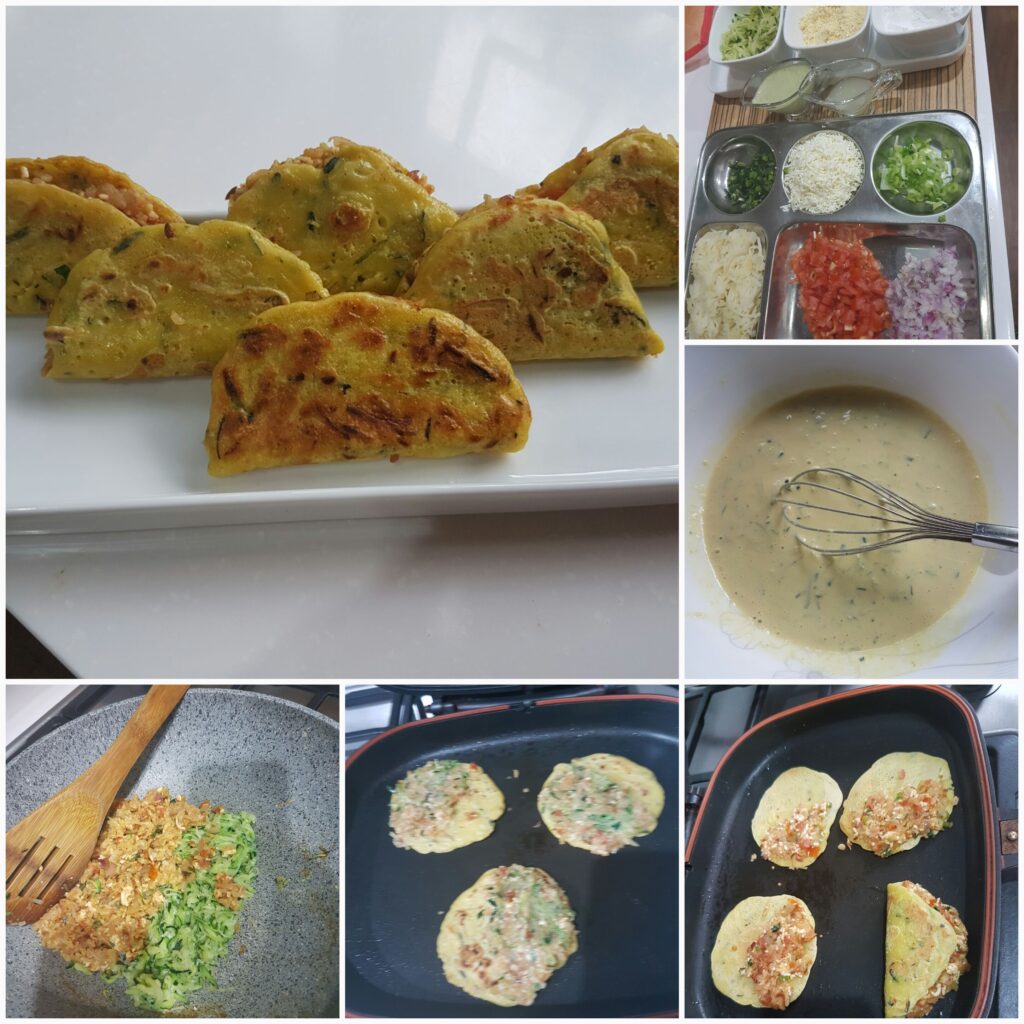
nother vegetable which has recently been introduced to Indian cuisine is zucchini. This vegetable resembles a cucumber in appearance but has a firmer texture and seeds which are very tiny and almost invisible. It is an emerald green colour and comes from the family of squash. The only difference is that it is harvested quite early, when it reaches a length of about 25 cm, to prevent it from losing its taste. This vegetable, which is a storehouse of nutrients, adapts itself very well to any cuisine, sweet or savoury. Be it a zucchini fritter or just simply tossed with a few herbs and roasted, it makes a great side dish and is very healthy. Today I would like to share with you a snack made with shredded zucchini which I have adapted to an Indian taste. This snack can be pre-made and then reheated and served. The use of oil is very minimal in this snack, and it is a good option for those of you trying to avoid deep-fried snacks. We as mothers know that children are fussy when it comes to eating vegetables. I learnt how to play hide and seek with vegetables in many forms when my children were growing up, sometimes in parathas, sometimes in cakes and idlis. There were beetroot parathas, carrot Sindhi kokis, or spinach idlis, etc. But nowadays young mothers are more health conscious and train their children from an early age to eat healthy. Zucchini is definitely a vegetable which should occupy a permanent space in your vegetable drawer. Ingredients Method
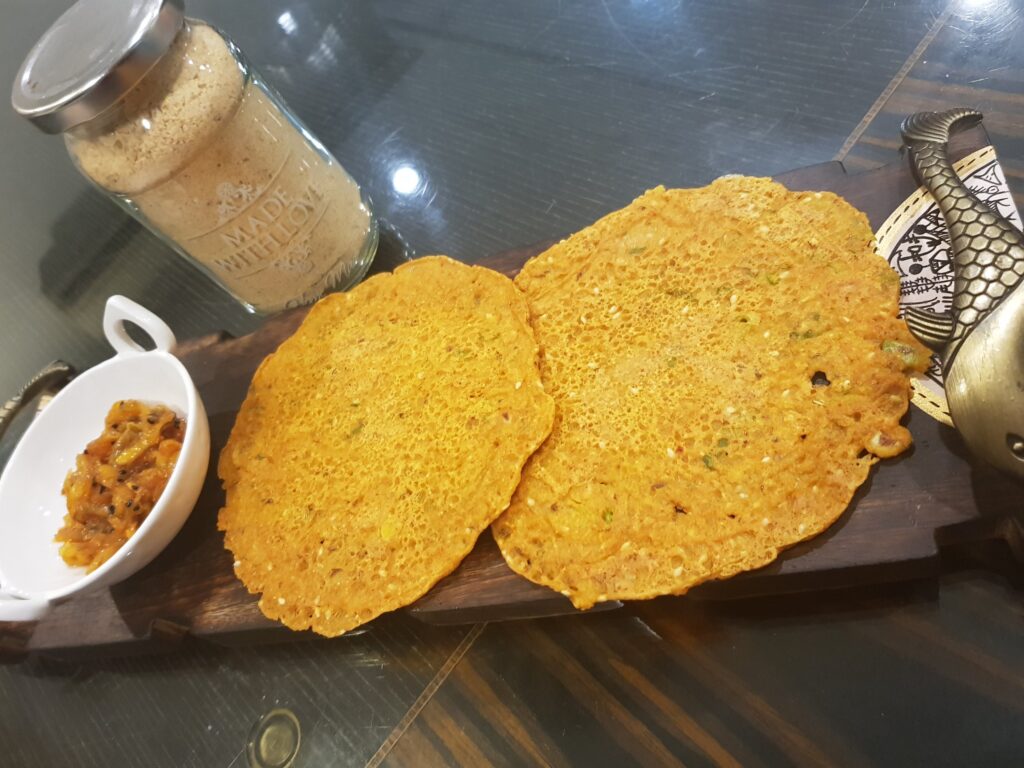
Years ago broccoli was a rather unknown vegetable on the Indian table. We Indians know all about the sister counterpart of broccoli, that is the cauliflower, more popularly known as gobi. Every region of India has its own tasty version of gobi, with gobi aloo heading the list. Imagine eating gobi aloo accompanied by a hot elaichi-flavoured moong dal khichdi, washed down with a glass of chilled lassi. Hmmmm, comfort food at its best. The advent of broccoli in India is quite recent, though India is among the top producers of the vegetable. Its popularity is more in the Chinese food world. This lovely emerald green vegetable is a storehouse of nutrients and is a great antioxidant too. It also does not require too much cooking. Having it sautéed with garlic and seasoning, accompanied by steamed rice, makes for a very healthy and tasty dish. This vegetable is also very versatile and can blend with other vegetables such as mushrooms, tofu, and young baby corn. It is also very delicious with a cheddar cheese sauce poured over it and gratinated until golden. I have used broccoli in various ways at home, right from a broccoli tikki up to a broccoli pancake. Today I will share with you a very simple pancake made with semolina and broccoli. This pancake is a great evening snack, or it can even be had for breakfast. It is made in a jiffy and can be prepared beforehand and reheated before serving. I normally serve this with a coconut chutney. Do try it. Broccoli Pancake For the Pancakes Method For the Broccoli Mixture Method
Ever since I can remember, I have loved dhoklas, the lovely low-calorie snack which rules Gujarat and also many parts of Western India. It is available in almost all sweetmeat shops, especially those run by Gujaratis or Marwaris. This snack, which is steamed and then tempered with mustard seeds and sesame seeds, is delightfully soft and fluffy when made right. Oh, the pleasure of biting into a piece of freshly made dhokla topped with a cold coconut chutney, supreme pleasure. And I can tell you that every family guards their dhokla recipe very closely. For years I have tried to make the perfect dhokla and have tried so many recipes, some of which have seen the bin and some of them my table. And just when I think, okay, that is it, this is the perfect recipe, along comes another version which I feel is better than the first. But finally, after many trials and errors, I have found my version of the dhokla, which I am going to stick to for a long time. My version is made from semolina, which I love. I know this would not be what is made in many Gujarati households, where dhoklas are traditionally made with soaked and ground chana dal or besan. But it is an instant version which can be made in a jiffy with just a few ingredients. Do try it. Instant Rawa Dhokla Ingredients Method Tempering
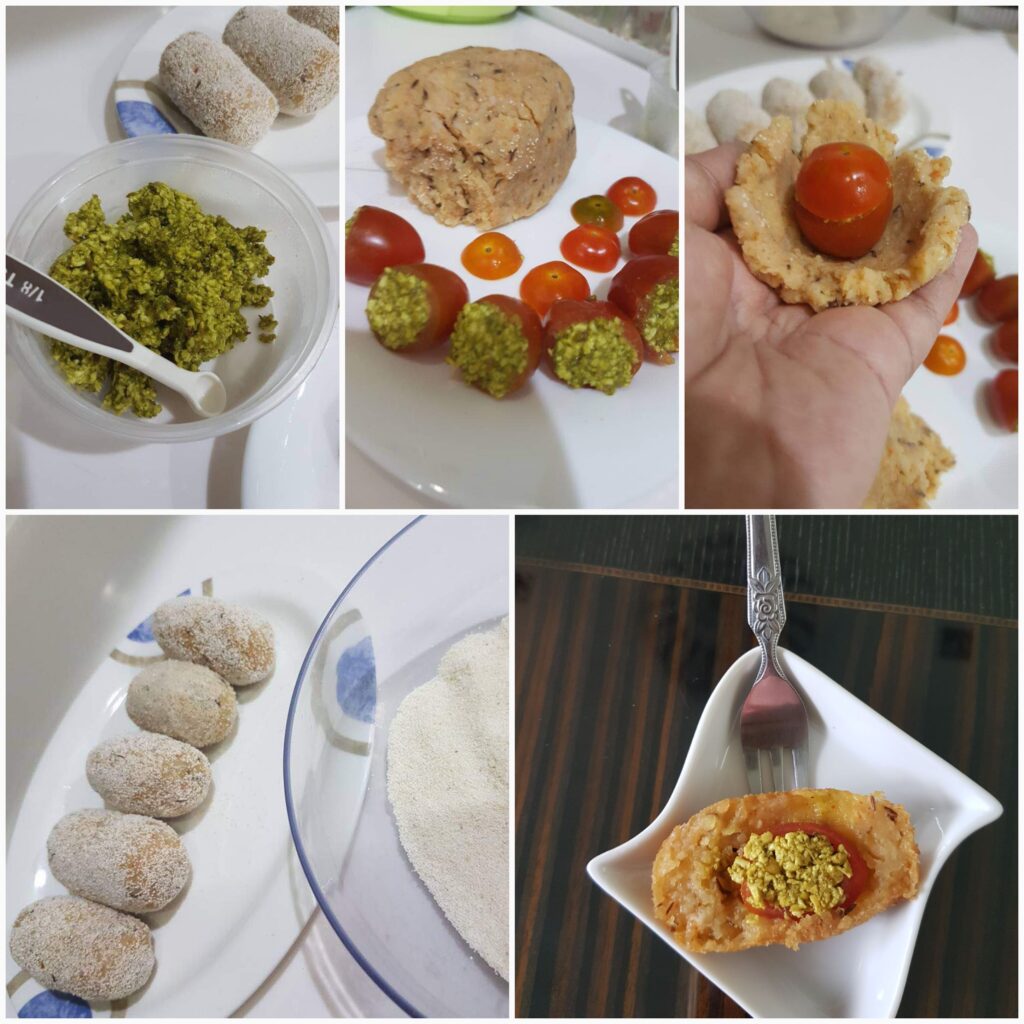
Snacks are an all-time favourite with everyone. We all feel these hunger pangs in between meals. Of course nowadays the trend is to snack healthy and we are advised to eat nuts, fruits, and energy bars in lieu of farsans, fried snacks, and sweets. But truthfully, who does not like biting into a hot crisp samosa which has been dunked into a spicy mint chutney or a tangy tomato chilli sauce? Or even a simple fried potato tikki which is so crispy on the outside and soft on the inside? I must confess, I cannot resist fried snacks. I would rather eat a fried tikki once in a way rather than a pan fried one ever so often. But with all due respect, not all snacks are fried, and many non-fried snacks taste equally delicious. Gujarat, for instance, has given us many steamed wonders such as the different varieties of dhoklas, my personal favourite, the melt-in-your-mouth khandvis, the methi muthiyas, etc. Heading south, you get a mixed variety, the steamed idiyappams, idlis, or the crisp medhu wadas. Maharashtra is the state where I was born, and what should I say about our Maharashtrian snacks, I could go on and on. Sabudana wadas, kothimbir vadis, bhakarwadi, and who has not heard of the famous vada pav? Crispy besan-coated spicy potato balls, deep fried and served between a slit pav with generous lashings of garlic and chilli chutney. This street food is one of the most popular snack items sold on the streets. Its price suits all pockets, from the poor man to college students and to the rich who arrive in their Mercedes to buy it. It is also called the poor man’s burger. As young children, snacking was sometimes as simple as a slice of bread with jam on it or even some butter and bread, and then we were off running to meet our friends to play hopscotch or hide and seek. Those were the carefree days of childhood. One memory that stands out is coming home from school to the pungent smell of green chutney being ground on the stone slab by our old helper Girgabai. The fragrance of mint, coriander leaves, and spicy green chillies literally filled the house once a week because Baba loved his chutney to be made in the old-fashioned way. He really enjoyed eating his chutney dabroti, bread as it is called in Sindhi. Today I would like to share with you a snack which I learnt in my cooking group, the Fun and Food Ladies Group, of which I am privileged to be a member. For almost 25 years, this wonderful group has been active in Jakarta for almost 40 years and has members of all age groups. We gather monthly at different members’ homes and we share recipes and host lunches. Today I can truly say that over the years I have learnt a lot of cooking and many other things from the ladies in this group, all of whom are now dear friends. The Sandwich Ball Ingredients Method
Biscuits. Rare is the person who has not eaten biscuits, sweet, salty, or spicy. There are thousands of varieties of biscuits or cookies all over the world. Each country has its own speciality, be it shortbreads, butter cookies, or sandwich cookies, and the list is endless. Growing up in Pune, our biscuits and cakes were from the famous Parsi bakeries which Pune is famous for, namely Kayani Bakery, Royal Bakery, and Pasteur Bakery, to name a few. These bakeries sell biscuits and cakes with recipes which are handed down over generations, and the best part is that over the years the taste and quality remains the same. Anyone who has been to Pune will vouch for the melt-in-your-mouth Shrewsbury biscuits of Kayani Bakery or the cheese papadi, and not forgetting the khari puff biscuits. It is no wonder that their cakes, biscuits, and breads are sold out even as they are made. Each bakery has its speciality which loyal customers keep going back for. I remember how Baba wanted bread only from Royal Bakery, and mummy used to tell me to go pick it up, and me cutting across Bhimpura Lane to buy the bread happily because it gave me a chance to go to my favourite library, the Punjab Library, where the owner, Uncle Manguram, had the most fabulous collection of Mills and Boon books and comics. Royal Bakery also had the most amazing glass cakes, so called because of their shape. These buttery milky cakes were super soft. Pune in the 1970s had some pretty well known bakeries, many of them still around even today. Sadly some have shut down, like the Sham Sunder Bakery, where nankhatais were really delicious. Those were the good old days. I am not too much into baking, but recently my son Sagar encouraged me to start baking cookies, and so began the search for some of my old recipes for cookies. Today I share with you a recipe for coconut cookies. These remain crisp for a long time due to the pure butter used. Coconut Cookies Ingredients Method If you like a slightly chewy texture, then do not flatten the cookies.